
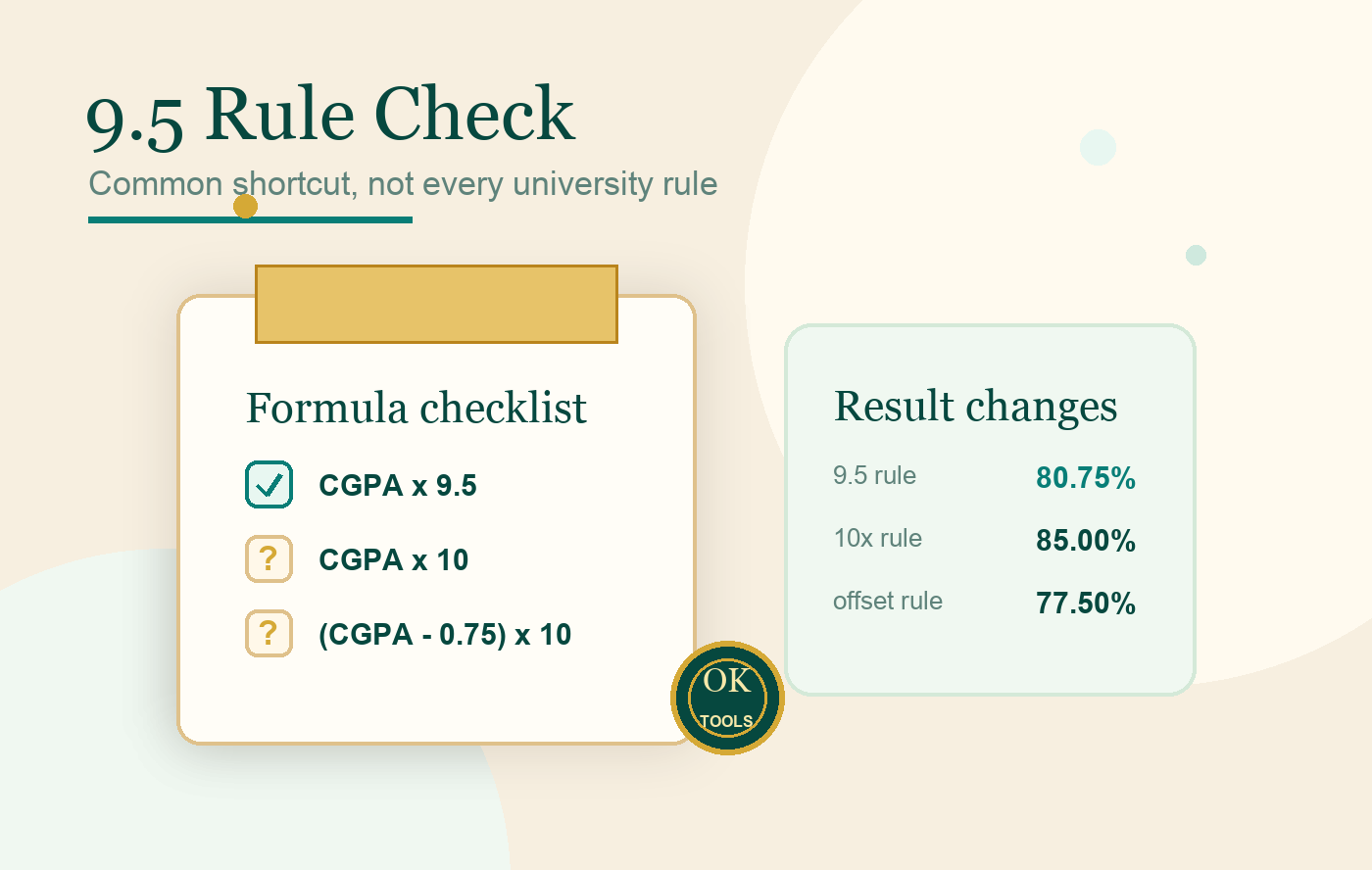
CGPA x 9.5 is useful because it is simple and widely recognized, but it is not a law of grading. Many institutions use offsets, direct 10x conversion, grade bands, or course-specific rules.
Related toolCGPA to Percentage CalculatorCompare the common 9.5 shortcut with other selectable conversion methods.
Check a CGPA →Why The Rule Became Popular
The 9.5 multiplier is easy to calculate and fits many 10-point scale estimates. Students use it because it gives a quick, explainable number.
That convenience is exactly why you should label it as a method, not as an official percentage unless your institution says so.
Where It Can Fail
Some universities subtract a value before multiplying, such as (CGPA - 0.75) x 10. Others use CGPA x 10 or a linear formula with an added constant.
Program year, regulation scheme, and department can also matter. A formula that fits one batch may be wrong for another.
A Safer Submission Habit
Use the calculator for a quick estimate, then keep the selected method visible. If a form has a remarks field, write the conversion rule there.
For official documents, ask the exam office or use the conversion certificate when available.
Common Questions
Why do different formulas give very different results?
They represent different grading policies. The formula is part of the institution's evaluation system, not only arithmetic.
What should I do if no rule is listed?
Use a clearly labeled estimate and ask the relevant office before final submission.