
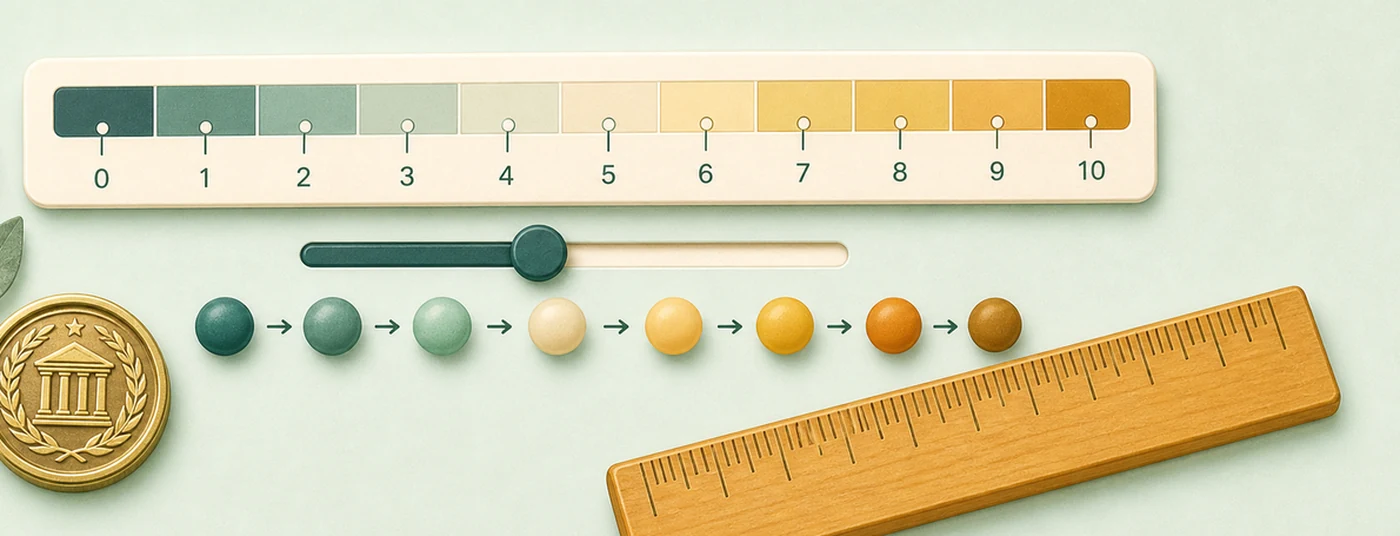
A CGPA scale is the rulebook that gives meaning to a CGPA number. A score of 8.0 can be strong on one 10-point scale, but it cannot be compared directly with a 3.2 on a 4-point GPA scale unless you know how both systems define grades, credits, and conversion. Many students search for a CGPA scale when they need to understand letter grades, percentage ranges, transcript legends, or application cutoffs. This guide explains how common CGPA scales work, what the 10-point and 4-point systems mean, and how to avoid mixing scales when you calculate or convert results.
Scale-aware toolCGPA CalculatorUse grade points and credit hours together so the final CGPA follows your school scale.
Calculate with credits →What A CGPA Scale Means
A CGPA scale maps academic performance to grade points. In a 10-point system, the highest grade point is usually 10. In a 4-point GPA system, the highest value is usually 4.0. Some institutions use 5-point, 7-point, percentage band, or custom grading systems. The scale does not only name the maximum score; it also defines how letter grades, marks, credits, pass grades, and failed attempts become grade points.
This is why CGPA should not be read as a simple fraction without context. An 8 out of 10 looks like 80%, but many universities do not convert it by multiplying by 10. A 3.5 out of 4 looks like 87.5%, but that direct percentage is not automatically official either. The scale is the source of truth, and the transcript legend or university handbook usually explains it.
The Common 10-Point CGPA Scale
A 10-point CGPA scale is common in many universities and technical programs. The top grade may be listed as 10, 9, 8, and so on, or it may use letter labels such as O, A+, A, B+, B, C, and P. A typical table might map O to 10, A+ to 9, A to 8, B+ to 7, B to 6, and lower passing grades to smaller point values. Your school can use different labels, so treat any online table as an example until you confirm it.
The 10-point scale is also where many percentage questions begin. Some students use CGPA x 9.5, some use CGPA x 10, and some schools publish a different formula. The scale tells you the grade point range, while the conversion rule tells you how to estimate percentage. They are related, but they are not the same thing.
How A 4-Point GPA Scale Differs
A 4-point GPA scale is common in the United States and in many international application systems. In a simple version, A may equal 4.0, B may equal 3.0, C may equal 2.0, and D may equal 1.0. Some schools add plus and minus values, such as A- = 3.7 or B+ = 3.3. Others use weighted honors or advanced course rules. Because the maximum is 4.0, the numbers cannot be compared directly with a 10-point CGPA.
For example, 8.0/10 is not automatically the same as 3.2/4.0, even though both are 80% of the maximum if you divide the numbers mechanically. Admissions offices often ask for the original score, the scale, and sometimes an official conversion from the school. When you apply internationally, keep the original CGPA visible and avoid changing scales unless the form gives a method.
Letter Grades And Grade Points
Many transcripts show letter grades first and grade points second. The letter is a readable label, while the point value is the number used in CGPA calculation. If your transcript says A = 9 points and B = 7 points, those point values are what go into the weighted formula. If another university says A = 4 points and B = 3 points, that belongs to a different scale.
Do not assume the same letter means the same performance everywhere. One school may reserve A+ for 90 and above, while another may use A+ for 85 and above. One program may have relative grading, where grade bands shift based on class performance. Another may have fixed marks ranges. Letter grades are useful, but the official grade point table is what makes them calculable.
Marks Range Is Not Always The Same As CGPA
A marks range table tells you which percentage marks produce a grade. A CGPA scale tells you which grade point is assigned to that grade. These can look similar, but they answer different questions. If 80 to 89 marks earns an A grade and A equals 9 grade points, the mark range is not the same as saying 9 CGPA equals 80% or 89%. It only describes how one course grade may be assigned.
Cumulative CGPA also includes course credits. A student can score high marks in a low-credit course and average marks in a high-credit course, and the final CGPA will reflect the credit weights. That is why converting a cumulative CGPA back into marks is usually an estimate unless the university gives an official conversion certificate.
Weighted Credits Still Matter
The scale gives each grade a point value, but credit hours decide how much each point value counts. A 10-point grade in a 1-credit course contributes 10 weighted points. A 7-point grade in a 4-credit course contributes 28 weighted points. The larger course can move the final average more, even with a lower grade point.
When you calculate CGPA, use both pieces: the official grade scale and the official credit map. First convert each letter or marks result into a grade point. Then multiply by credit hours. Add weighted points, add credits, and divide. A correct scale with wrong credits can still produce a wrong CGPA.
Conversion Between Scales Needs A Rule
Students often ask how to convert 10-point CGPA to 4-point GPA or percentage. The safest answer is: use the rule required by the receiving institution. Some application systems ask you not to convert at all. Others provide a table, a credential evaluation service, or a university-specific formula. A generic ratio can be useful for planning, but it may not be accepted for official review.
If you must show an estimate, label it clearly. For example, write original CGPA: 8.20/10, percentage estimate: 77.90% using CGPA x 9.5. If a form asks for GPA on a 4-point scale, check whether it accepts self-reported conversion. When the stakes are high, the original transcript and official scale are more reliable than a shortcut.
How To Read Your Transcript Scale
Start with the transcript legend. Look for the maximum grade point, pass grade, failed grade, credit policy, and rounding rule. Check whether pass/fail, audit, internship, project, thesis, backlog, or retake courses are included in CGPA. If the legend is missing, check the student handbook, academic regulation, exam branch notice, or department course structure.
Keep a small note with four facts: scale maximum, grade-to-point table, credit rule, and conversion rule. Those four facts answer most CGPA questions. They tell you how to calculate the number, how to explain it, and whether it can be converted to percentage or another scale.
Common Questions
What is a CGPA scale?
A CGPA scale is the official grading system that maps marks or letter grades to grade points, such as a 10-point scale or a 4-point GPA scale.
Is 8 CGPA the same as 80%?
Not always. A direct 10x estimate gives 80%, but many institutions use CGPA x 9.5 or another official formula. Use the required conversion rule.
Can I convert a 10-point CGPA to a 4-point GPA?
Only with an accepted conversion rule. Many schools and applications prefer the original score with the scale shown instead of a self-converted GPA.
Do letter grades have the same points everywhere?
No. A, B, and other letter grades can map to different point values depending on the university, program, and grading regulation.