
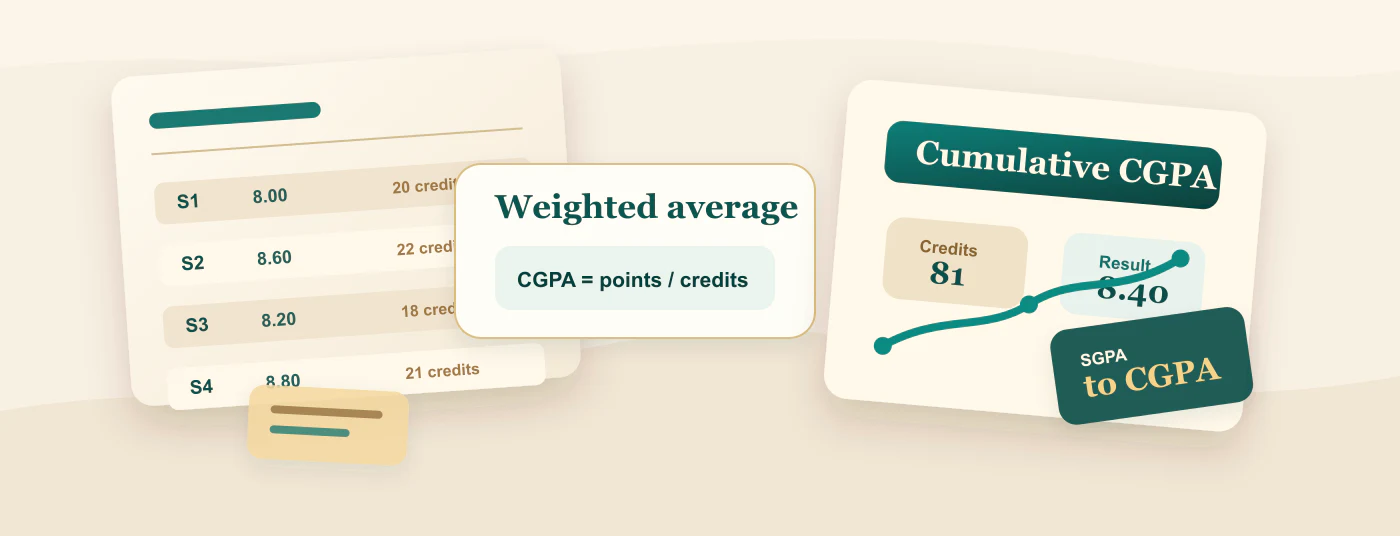
SGPA to CGPA conversion is the calculation that turns separate semester results into one cumulative academic average. The safest method is usually credit-weighted: multiply each semester SGPA by the credits completed in that semester, add the weighted totals, and divide by total credits. When credits are not available, a simple average can help with planning, but it may not match the official transcript. This guide explains both methods, shows how to combine a previous CGPA with a new semester, and lists the checks that matter before you submit the number.
Semester calculatorCGPA CalculatorEnter semester results, credits, and grade points to check the cumulative average.
Open calculator →SGPA And CGPA Are Related But Not The Same
SGPA usually means Semester Grade Point Average. It summarizes one semester or term. CGPA means Cumulative Grade Point Average. It summarizes all semesters that are included in the official record. The two numbers use the same grading scale in many universities, but they answer different questions: SGPA shows recent performance, while CGPA shows the weighted academic record so far.
A student can have a strong SGPA in the latest semester and still see only a small CGPA increase if many credits were already completed earlier. This does not mean the semester was wasted. It means the cumulative average has memory. Older credits continue to carry weight until the program ends.
Use The Credit-Weighted Formula First
The most reliable formula is CGPA = total weighted semester points / total credits. For each semester, weighted semester points are calculated as SGPA x semester credits. After you calculate that value for every semester, add all weighted semester points and divide by all completed credits.
For example, if Semester 1 has 8.00 SGPA across 20 credits, it contributes 160 weighted points. If Semester 2 has 8.60 SGPA across 22 credits, it contributes 189.20 weighted points. The combined CGPA is (160 + 189.20) / (20 + 22), which equals 8.31. Credits decide how much each semester affects the cumulative result.
When A Simple Average Is Only An Estimate
If every semester carries the same credit load, a simple average of SGPA values can match the credit-weighted result. If four semesters are 8.0, 8.4, 7.8, and 8.6 with equal credits, the average is 8.20. That is easy and useful when your school treats every semester equally.
The problem appears when semester credits differ. A 24-credit semester should not be treated the same as a 16-credit semester unless your official rule says so. If credits are missing, use a simple average only as a planning estimate and label it clearly. For submission, find the credit totals from the transcript, syllabus, portal, or department course structure.
Combine Previous CGPA With A New SGPA
Sometimes you do not have every old semester row, but you do have previous CGPA and completed credits. In that case, convert the previous CGPA back into weighted points first. Previous weighted points = previous CGPA x completed credits. Then add the new semester's weighted points and divide by the new total credits.
Suppose a student has 8.10 CGPA after 80 credits. Previous weighted points are 8.10 x 80 = 648. A new semester has 8.80 SGPA across 20 credits, adding 176 weighted points. The new cumulative CGPA is (648 + 176) / 100 = 8.24. This method is often the fastest way to forecast whether a current semester can move the final average.
Check Which Credits Are Included
Not every credit shown on a record is always included in CGPA. Some pass/fail courses earn credits without grade points. Some audit courses appear for record keeping but do not affect the average. Internships, thesis work, projects, labs, and backlog courses can follow separate rules. Before converting SGPA to CGPA, confirm which credits belong in the numerator and denominator.
If your semester SGPA was already calculated by the university, the semester credit total should match the courses included in that SGPA. Do not add extra non-graded credits unless the regulation includes them. A correct SGPA can still lead to a wrong CGPA if the semester credit value is copied from the wrong table.
Retakes And Failed Courses Can Change The Result
Retakes can make SGPA to CGPA conversion more complicated. In some universities, the new attempt replaces the old grade in the cumulative calculation. In others, both attempts remain visible, or the newer attempt is capped. Failed courses may count as zero grade points until cleared, or they may be excluded until the credit is earned.
Before relying on a retake to improve CGPA, check the rule for your batch and program. Ask whether the old semester SGPA will be recalculated, whether the completed credits change, and whether the replacement appears in CGPA immediately. These details explain why two students with the same new SGPA may see different cumulative changes.
Round After The Final Division
Keep enough decimals while you calculate. Rounding every semester contribution can shift the final CGPA, especially across many terms. Multiply SGPA by credits, add the weighted values, add credits, and divide first. Then round the final result according to the transcript or form requirement.
Two decimal places are common, but not universal. Some institutions show three decimals. Some portals round to one decimal or store more precision internally. When you are submitting a CGPA, copy the official transcript value if available. If you are estimating, say that it is an estimate and keep the formula visible.
A Practical Workflow Before Submission
Start by listing each semester, SGPA, and semester credits. Multiply SGPA by credits for every row. Add weighted points and add credits. Divide the totals, round only at the end, and compare the result with the official portal if one is available. If the numbers differ, check credits, retakes, pass/fail courses, failed attempts, and rounding.
For resumes, applications, and scholarship forms, keep the original scale visible. A clear label is: CGPA 8.24/10, calculated from semester SGPA values using credit-weighted credits. If a form asks for percentage, convert only after the CGPA is confirmed, and use the conversion rule required by that form or institution.
Common Questions
How do I calculate CGPA from SGPA?
Multiply each semester SGPA by that semester's credits, add the weighted totals, and divide by total completed credits. If credits are equal, a simple average may match.
Can I average SGPA values to get CGPA?
Only when every semester carries the same weight or your institution uses equal semester weighting. If credits differ, use the credit-weighted formula.
How do I add a new semester to my old CGPA?
Multiply previous CGPA by previous completed credits, add the new SGPA x new semester credits, then divide by the new total credits.
Why did a high SGPA only raise my CGPA a little?
CGPA includes older completed credits. When you already have many credits, one new semester has less influence on the cumulative average.